
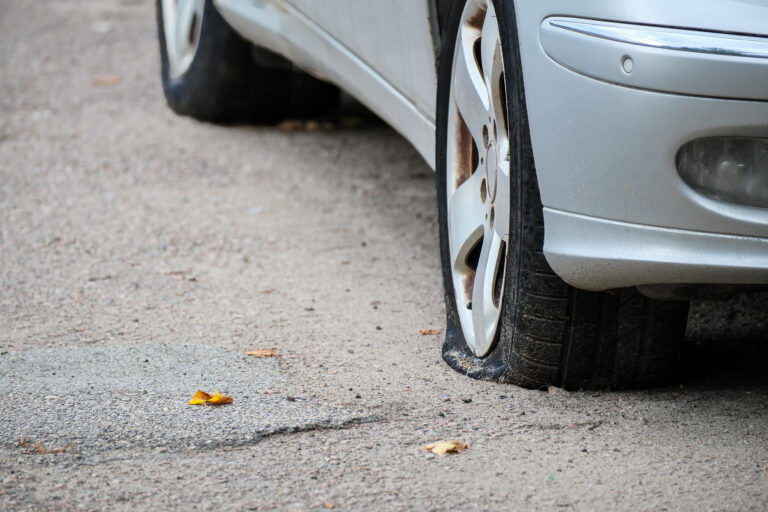
Every May, temperatures in Las Vegas push toward 100°F fast—and for the trucks and passenger vehicles already rolling on worn tires, that heat can be the last straw. A Las Vegas tire blowout accident on US-95 or the 215 Beltway isn’t always a freak event. Sometimes it’s the foreseeable result of a driver—or more often, a commercial carrier—skipping the maintenance that Nevada law and federal regulation require. That’s why the Las Vegas car accident lawyers here at ER Injury Attorneys have put together this helpful guide.
Why Nevada’s May Heat Is so Hard on Tires
Tire pressure increases roughly 1 PSI for every 10-degree rise in ambient temperature. When a truck leaves a distribution center in Henderson at 7:00 a.m. and the asphalt temperature has already climbed above 100°F by mid-morning, a tire that was marginally over-inflated at departure is now dangerously stressed.
Worn tires become increasingly susceptible as well. Worn treads are no longer able to release accumulated heat, so the material will break down quicker than usual under intense friction and temperature. Suddenly, everything stops working, and before you know it, 200 pounds of shredded tire casing are barreling towards you at 70 miles per hour.
Defense Against an Act of God in Las Vegas Tire Blowout Accident Cases
Immediately following an accident caused by a blowout, commercial trucking companies often attempt to characterize the occurrence as an inevitable accident, which was caused by sudden and unpredictable equipment failure. A US-95 truck crash lawyer can dispute this.
In Nevada, the heat of the Mojave desert in springtime is as unavoidable as the rising of the sun. Trucking companies that work in this area know about the conditions here, and they know how such conditions affect worn-out tires. With that said, the Federal Motor Carrier Safety Administration (FMCSA) mandates that pre-trip inspection should be done before each trip to detect such problems.
When a trucker gets into the truck, signs his name on the Driver Vehicle Inspection Report (DVIR), and drives away with a bald-tired truck towards US-95 – that is not an act of God. That is negligence.
Commercial Truck Tires: Nevada Commercial Vehicle Maintenance Laws
Federal and state law create overlapping requirements that commercial truck operators must meet before a rig hits Nevada highways.
FMCSA regulations (49 CFR Part 393) set minimum tire tread depth at 4/32 of an inch on steering axles and 2/32 of an inch on all other axles. Tires that fall below those thresholds are out-of-service violations. A carrier that knowingly dispatches a truck with non-compliant tires is in violation of federal motor carrier safety standards.
Nevada NRS Chapter 484D governs vehicle equipment standards for all vehicles operating on state roads, including commercial carriers. Tires must be free from cuts, bulges, or exposed cords. Over-inflation in excess of the manufacturer’s maximum load rating is also a prohibited condition.
Beyond equipment standards, FMCSA Part 396 requires systematic inspection, repair, and maintenance programs for every commercial motor vehicle. Carriers must keep records of those inspections. When those records are subpoenaed after a crash, they often tell a story the carrier would prefer stayed private—tires flagged for replacement that never got replaced, or inspections that look suspiciously identical from one day to the next.
How We Investigate a Las Vegas Tire Blowout Accident
At ER Injury Attorneys, a tire blowout case on US-95 or the 215 isn’t filed and forgotten. It’s built from the evidence up, before that evidence disappears.
Maintenance and inspection records. We request DVIRs, maintenance logs, and the carrier’s internal inspection schedules. What was documented? What was ignored? What was signed off on the morning of the crash? All of this information is important for your personal injury claim.
The tire itself. Physical tire remnants are evidence. A forensic tire analysis can determine whether the failure was the result of road hazard penetration (which might support the “unavoidable” argument) or chronic under-inflation, excessive wear, or internal structural separation (which points directly to negligence).
Electronic logging and ECM data. The truck’s engine control module often captures speed, braking behavior, and event data in the moments before and after a blowout. We move quickly to preserve that data before it’s overwritten.
Cargo and load records. An overloaded trailer puts excessive stress on tires. Load documentation can establish whether the truck was operating within its rated capacity.
Driver qualification file. If a driver had prior inspection violations or had flagged tire concerns to a dispatcher who ignored them, that information matters.
When a tire fails on a commercial truck in 100-degree Nevada heat, the liability question almost never ends with the tire itself.
Highway Debris Accidents: When the Tire Isn’t the Only Problem
Not every highway debris accident in Las Vegas involves a direct collision with the truck. Sometimes the vehicle that causes the crash is long gone. A shredded tread in the lane, a piece of steel belt on the shoulder, a retread fragment left on US-95 near the I-215 interchange—these debris fields injure and kill drivers who had no contact with the truck that shed them.
Nevada law recognizes that the party responsible for the debris on the road can be held liable for the damage it causes, even if there’s no direct collision. Identifying and pursuing the responsible carrier requires fast investigation. Traffic camera footage, witness accounts, and nearby commercial truck GPS data can help establish which vehicle left the debris and when.
If you were injured by tire debris on a Las Vegas highway, don’t assume it was just bad luck. It may have been someone’s failure.
Here to Help With a Las Vegas Tire Blowout Accident
The Las Vegas personal injury lawyers at ER Injury Attorneys are here to provide you with the information you need when it comes to a Las Vegas tire blowout accident—and we’re here if you need help with the claim process after a wreck.
We’re available to help you 24 hours a day, 7 days a week. You can reach us right now by dialing 702-878-7878 and online through LiveChat or the contact form.
We represent accident victims throughout Southern Nevada, including Henderson, Summerlin, Pahrump, Boulder City, Laughlin, and beyond. Get in touch with us today to get the legal advocacy you need.
The information on this blog is for informational purposes only. It is not meant to serve as legal advice for an individual case or situation. This information is not intended to create an attorney-client relationship nor does viewing this material constitute an attorney-client relationship.